Strategy
How Modern AI Engineering Interviews Work in 2026
AI can accelerate implementation, but modern interviews still reveal whether an engineer can frame problems, navigate systems, verify results, and own the final decision.
- AI Engineering
- Technical Interviews
- Agentic AI
- Evaluation
- Software Engineering
In brief
AI-assisted interviews are not only tests of coding speed. They can test whether an engineer clarifies incomplete requirements, navigates an unfamiliar system, uses AI within clear boundaries, verifies the result, and explains the trade-offs. This article presents a practical workflow for repository debugging, RAG, agent tools, evaluation, and production scenarios.
On this page · 7
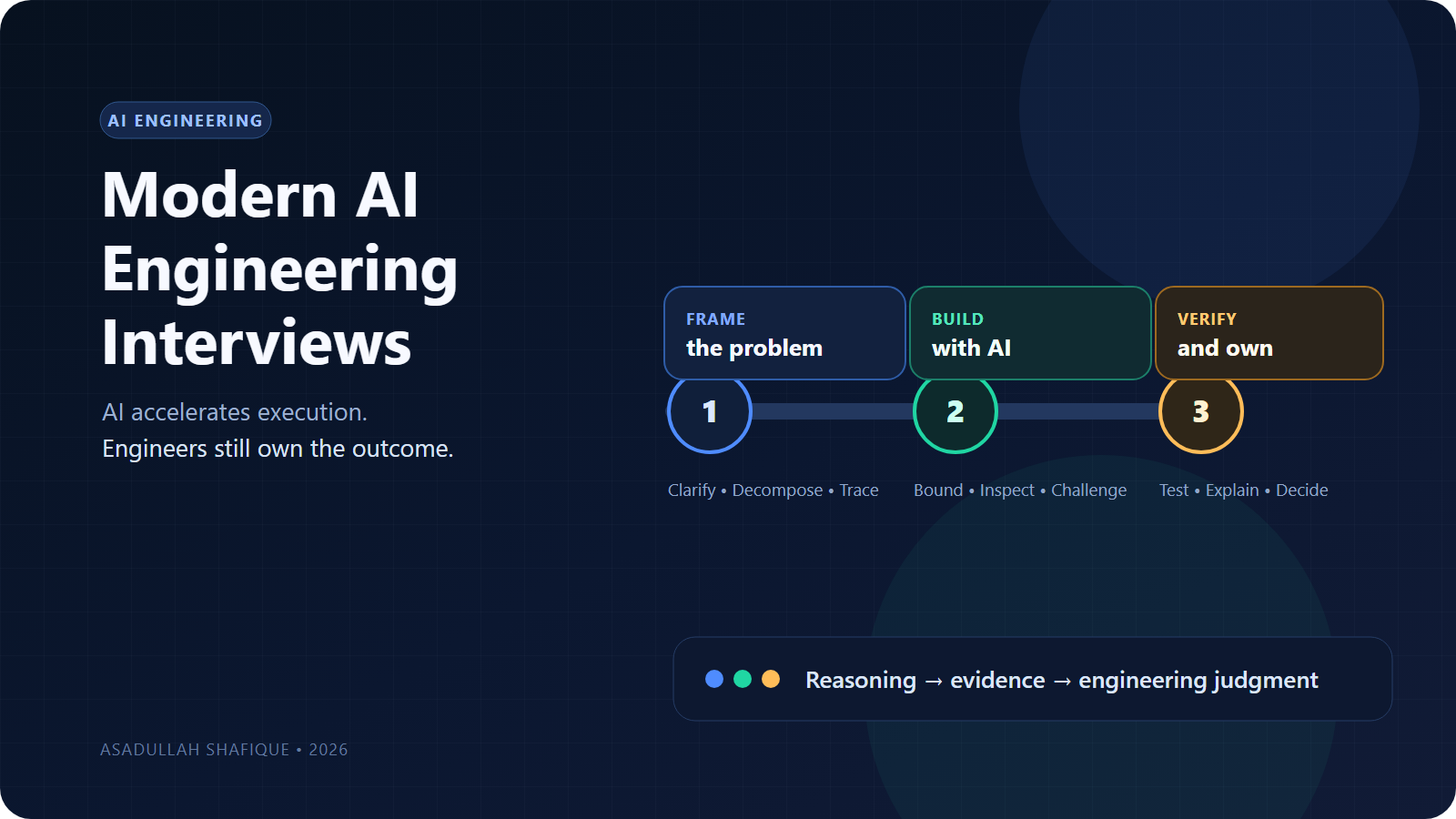
AI can help an engineer write code faster. That does not remove the need for engineering judgment. It makes judgment easier to observe.
In a modern AI engineering interview, the main question is often not, “Can you write every line without help?” It is closer to this:
Can you understand an unclear problem, use AI with control, verify the result, and take responsibility for the final decision?
This is not a universal rule for every company. Interview formats still vary. But for roles involving LLM applications, agents, retrieval, evaluation, or production AI systems, practical engineering work is becoming more important than memorized definitions.
The shift: from recall to engineering judgment
Traditional questions are still useful. An AI engineer should know how retrieval-augmented generation works, what embeddings represent, and how tool calling is implemented.
But knowing a definition is only the starting point. A stronger interview question puts that knowledge inside a failing system:
| Traditional question | Modern engineering question |
|---|---|
| What is RAG? | The correct document exists, but the answer is wrong. Where would you debug first? |
| What is an AI agent? | Why did the agent choose the wrong tool, and how would you prevent it? |
| What is fine-tuning? | Should this problem use prompting, RAG, fine-tuning, or a different model? |
| Explain embeddings. | Retrieval quality dropped after an ingestion change. How would you isolate the cause? |
| Build a chatbot. | Design an AI system that is reliable, observable, evaluable, secure, and cost-aware. |
The difference is application. The interviewer can see how you reason when requirements are incomplete, tools are available, and the first answer may be wrong.
What interviewers may be measuring
1. Problem framing and decomposition
A weak response starts building immediately. A stronger response first clarifies the goal, success criteria, constraints, and missing information.
You may need to ask:
- What behavior is expected?
- What example reproduces the problem?
- Which users or workflows are affected?
- What must not change?
- How will we know the solution works?
The next step is to break the work into testable parts. This reduces risk and gives an AI coding agent clearer boundaries.
2. Technical navigation
Real engineering rarely begins with one isolated function. You may receive an unfamiliar repository and a short bug report.
The interview can test whether you can quickly locate the service boundary, trace data flow, find relevant tests, and identify where actual behavior first differs from expected behavior.
AI can help search and summarize the codebase. You still need to check whether its explanation matches the source and runtime evidence.
3. Controlled AI-assisted execution
Good AI use is not measured by how much code the model produces. It is measured by whether the tool helps you reach a correct, maintainable result.
That means giving the agent precise context, limiting the files it may change, asking it to investigate before editing, and rejecting unnecessary abstractions. A small patch that addresses the root cause is often stronger than a large rewrite.
4. Debugging and root-cause analysis
An AI-generated explanation can sound convincing and still be wrong. Strong candidates form hypotheses and then look for evidence.
For each hypothesis, ask:
- Which log, trace, test, or code path supports it?
- What result should change if this hypothesis is correct?
- Am I looking at the cause, or only a symptom?
The goal is not to produce many possible explanations. The goal is to eliminate the wrong ones.
5. Review and verification
Generated code must be reviewed like any other code—usually more carefully, because fluent output can hide incorrect assumptions.
A convincing solution reproduces the original failure, adds a regression test, covers important edge cases, and runs the relevant test suite. It also checks for security, cost, latency, and operational side effects when those factors matter.
6. System-level judgment
AI systems create trade-offs. A higher-quality model may cost more. More agent steps may improve flexibility but increase latency and failure points. A larger retrieval context may add information while reducing focus.
An interview may test whether you can explain these trade-offs and choose a design that fits the actual constraints—not the most impressive diagram.
Common AI engineering interview formats
AI-assisted repository debugging
You receive a repository and a reported behavior. Your task is to understand the architecture, reproduce the failure, trace the execution path, form a hypothesis, and use AI to help investigate possible fixes.
The strongest finish is usually a minimal patch, a regression test, the relevant test results, and a clear explanation of the root cause and trade-offs.
AI-assisted feature implementation
You receive an incomplete feature request. The missing details may be intentional. Before implementation, you need to clarify behavior, failure handling, integration boundaries, logging, and performance expectations.
The agent can help implement the feature, but you remain responsible for scope and architecture.
RAG debugging
The correct source may exist while the answer remains wrong. The failure could be in ingestion, parsing, chunking, metadata, embeddings, retrieval, reranking, context construction, generation, or citation mapping.
The interview tests whether you can inspect the pipeline stage by stage instead of treating RAG as one black box.
Agent and tool-use debugging
An agent may choose the wrong tool, send invalid arguments, misread a tool error, or enter a loop.
You may need to inspect tool descriptions, schemas, permissions, state transitions, traces, and recovery behavior. The right fix might be a prompt change, but it might also require validation or deterministic application logic.
Production incident analysis
Quality drops, latency increases, costs rise, or one user group starts failing after a change.
Here, order matters. First understand impact and reduce harm. Then inspect telemetry, identify the change, fix the cause, and add detection or prevention so the failure does not return silently.
AI-generated code review
The code may look clean and pass basic tests. You still need to check correctness, maintainability, security, retries, failure handling, hidden model calls, data exposure, and expensive operations inside loops.
Reviewing AI-generated code is becoming as important as generating it.
Design, evaluation, and optimization
You may be asked to design an AI system and its evaluation plan together. A complete answer should cover datasets, metrics, human review, observability, failure handling, privacy, cost, latency, and rollback—not only the model or prompt.
A practical workflow for repository interviews
Use a simple sequence:
- Clarify the report, expected behavior, scope, and constraints.
- Reproduce the failure before editing.
- Navigate the architecture and trace the relevant path.
- Form hypotheses and rank them by evidence.
- Use AI deliberately to search, compare, or propose bounded fixes.
- Identify the root cause instead of patching a symptom.
- Apply the smallest safe change that resolves it.
- Add a regression test that fails before the fix and passes after it.
- Run focused and relevant broader tests.
- Explain the cause, change, evidence, risks, and trade-offs.
This workflow shows more than coding speed. It shows whether another engineer could review, trust, and operate your work.
What to prepare
Technical fundamentals still matter: programming, data structures, systems thinking, APIs, databases, networking, Git, testing, and the basics of machine learning and LLMs.
For AI engineering roles, add practical depth in these areas:
- LLM behavior, context windows, structured outputs, and tool calling
- RAG ingestion, retrieval, reranking, and context construction
- Agent workflows, state, permissions, and recovery
- Evaluation datasets, metrics, error analysis, and regression suites
- Reliability, observability, fallbacks, and incident response
- Security, authorization, prompt injection, and data handling
- Model selection, routing, cost, and latency
Then practice under realistic constraints:
- Understand an unfamiliar repository in a fixed time.
- Debug a deliberately broken retrieval pipeline.
- Inspect an agent trace and correct a tool-selection failure.
- Review generated code for hidden correctness and security issues.
- Build a small evaluation set and compare two system versions.
- Explain every important change as if you were opening a pull request.
How I practice this
- Agent Failure Atlas (Case 001) — reproducible agent-failure case
- OrchestratorX — supervisor routing as typed state, 41 tests
- GuardrailAI — deterministic compliance checks with hash-chained audit ledger, 42 tests
- ProtoBridge — MCP × A2A interoperability layer, 65 tests
The principle to remember
AI tools accelerate execution. The engineer remains responsible for reasoning, verification, trade-offs, and outcomes.
The strongest candidate is not the person who refuses AI, or the person who accepts every AI suggestion. It is the person who can use AI as an engineering tool while keeping the work understandable, testable, and under human control.
Update, 3 Nov 2026: now 74 tests passing (commit 69cd28a), and a live A2A demo is online at https://84-12-146-32.sslip.io/ (reference A2A peer only, synthetic data).
About the author
Asadullah Shafique
Agentic AI Systems Engineer
I build multi-agent systems: supervisor routing as typed state, deterministic guardrails with hash-chained audit ledgers, and MCP × A2A tool interoperability. I write here about the architecture and judgment behind them.
Related reading
The Architecture of Agentic AI: Building Autonomous Systems That Think, Plan, and Act
An LLM that answers is not an agent. An agent is a control system with a model inside it — and almost every property that makes it trustworthy lives outside the model.
- Agentic AI
- Architecture
- Orchestration
- Guardrails
Graph Engineering with Claude: A 14-Step Roadmap From 0 to Graph Architect
Most multi-step agents are a straight line — one head, one context, one thing at a time, until the window fills up. This is the 14-step roadmap that turns that line into a graph: one that fans out across a fleet, verifies its own findings, and converges on a result a lone agent could never hold.
- Graph Engineering
- Claude Code
- Multi-Agent
- Workflows
Closing the Deployment Gap: Why the Next Job Is Forward-Deployed, Not Another Demo Agent
Two groups are stuck for what look like opposite reasons — developers watching their work commoditise, companies watching pilots collapse on contact with real workflows. It is the same wall from two sides. The gap is not talent and not the model; it is deployment, and it closes with a System of Context.
- Forward-Deployed
- Agent Factory
- System of Context
- AI Engineering