







I connect agent architecture with real operational problems across Pakistan and the UAE.
Asadullah Shafique
Agentic AI Systems Engineer
CMT Industry Founder
Digital Marketer
I build production-oriented AI systems and run a textile sourcing business. That combination keeps my engineering grounded in real workflows, deadlines, inventory, customers, and measurable outcomes.
Agentic Systems
Orchestration, typed state, tool use, guardrails, evaluations, and graceful degradation—implemented as inspectable systems rather than presentation-only demos.
Operational Perspective
Founder experience in Pakistan’s textile value chain shapes how I translate messy business workflows into practical software.
Business Delivery
Engineering, digital strategy, and communication come together around one goal: moving a useful system from problem discovery to adoption.
“Asadullah transformed how we generate leads online. The digital marketing system he built (property portals, social campaigns, and the analytics dashboard) cut our cost-per-lead by over 40% in the first quarter.”
MA
Mohammed Al Rashidi
General Manager · Al Rashidi Real Estate, Dubai, UAE
Tech Stack
Technologies I use to ship production-ready applications, from agentic AI systems to cloud-native microservices.
The three disciplines I apply to every agent build. A model is not a product. The harness, the loop, and the graph around it are.
A model generates intelligence. The system determines whether that intelligence can be trusted.
01The Environment
Harness Engineering
What an agent can see and touch, decided in code rather than in a prompt: protocol-level tool access, read-only by default, a written constitution screened on the way in and on the way out, and typed state the model never reads.
> An agent that can call a write tool will eventually call it wrong. Capability is scoped before the model gets a vote: every tool on this site's MCP server is read-only.
Demonstrated inProtoBridgeMCP and A2A implemented to the wire, governance inside the envelope
MCP Servers
Read-only Tools
Guardrails
Typed State
02The Feedback
Loop Engineering
How quality is measured rather than asserted: eval suites that check the execution trace (which specialist ran, which tools it called) before a judge scores the prose. An answer that is fluent but never touched its tool fails.
> Evidence over confidence. When an eval case goes red, the fix goes into the agent, never into the case.
Demonstrated inevals/casesscored on the execution trace, not only on the prose
Eval Harness
Trace Assertions
LLM Judge
Regression Cases
03The Flow
Graph Engineering
Routing held in typed state and code, not in prompt text: an orchestrator hands off to exactly one specialist, specialists cannot hand off to each other, and a failed model or exhausted quota drops one rung down a fallback ladder instead of returning an error.
> A mesh of agents calling agents cannot be explained afterwards. A star with one recorded route can, and its routing can be tested with no API key.
Demonstrated inOrchestratorXrouting as typed state, asserted offline with no API key
Typed Routing
Handoffs
LangGraph
Fallback Ladder
// the whole stack, bottom to top
MODEL→
HARNESS→
LOOP→
GRAPH→
TOOLS · PROTOCOLS→
GUARDRAILS→
EVALUATION→
OBSERVABILITY
Reliable intelligence is an engineered system, not a prompt.
harness × loop × graph: the framework I apply to every agent build
// agent_trace
Agent Trace
One request through the orchestrator, stage by stage. Select a stage to inspect what the system does there — and which file does it.
Illustrative execution trace — representative values, real topology
The stages, the order and the file references below are the ones this site's agent actually implements. The field values are a representative run, not captured production telemetry.
REQUEST
State
inbound
Operation
POST /api/agent/chat
Outcome
A typed PortfolioContext is created for this run. It carries dependencies and the audit trail — never anything the model is expected to read.
Implemented in: backend/main.py
// engineering_evidence
Engineering Evidence
Six disciplines, and the artefact that proves each one. Every figure below was measured by reading the source, not carried over from a description.
Deterministic routing39 tests · 0 API keys
OrchestratorX keeps routing in typed state and plain Python, never in a prompt. That turns “the supervisor never skips ComplianceChecker” from a README claim into a millisecond CI assertion that runs offline.
ProtoBridge implements both protocols to the wire — real JSON-RPC over stdio in a subprocess, and a real HTTP peer serving an Agent Card — rather than simulating them. Governance rides inside the envelope, because transport headers do not survive an stdio hop.
GuardrailAI screens OFAC, AML and HIPAA Safe Harbor in plain Python before a model is reached. A control a model can argue its way past is not a control.
The FastAPI service behind this site — agent, MCP, contact, blog, GitHub and health paths. 8 tests fail on a clean tree (contact, GitHub stats, health), and CI runs the suite without blocking the build. Both are known and stated, not rounded away.
Agents SDK, then LangGraph, then static keyword answers. A dead key or an exhausted quota drops a rung instead of returning a 500, so the deployed site never hangs on a spinner because a provider is down.
Typed shared state records which specialist ran and which tools it called, so a run can be explained after the fact — and so an eval can fail an answer that was fluent but never touched its tool.
The stack behind this site, reporting its own state as you read this.
Reachability and latency are measured on request. Capability figures — tools, specialists, enforcement mode, fallback order — are reported by the running service. This is a service readout, not execution telemetry: the endpoint exposes no per-request traces, token counts or error rates, so none are shown.
When the backend is asleep or unreachable, both panels say so and print the outage. A status panel that only renders when the news is good is decoration.
Seven disciplines between a customer problem and a system in production. Each one names where it lives in this codebase, so none of it has to be taken on trust.
01
Full-Stack Depth
Linux, frontend, backend, APIs, databases and auth — enough to trace a failure end to end instead of guessing which layer broke.
└ src/app/ · backend/main.py · alembic/
02
Systems & Design
Services, queues, state and failure paths. Plan for scale before adding more agents, not after they start timing out.
└ backend/orchestration/ · the fallback ladder in agent.py
03
AI Engineering
RAG, memory, tool calling, structured outputs, guardrails and evaluations — the six things that separate an agent from a demo.
└ backend/constitution/ · evals/ · /mcp/server
04
Production Delivery
Cloud, infrastructure as code, CI/CD, network policy and health checks, with a fallback ladder that degrades instead of failing.
└ k8s/ · .github/workflows/ · backend/Dockerfile
05
Problem Discovery
Find the bottleneck that costs real money, then ship the smallest slice that works end to end before widening it.
└ Problem → Solution → Impact, on every project card
06
Business Impact
Tie the delivery to time saved, errors removed or revenue moved — not to tokens served or agents spawned.
└ 40% lower cost-per-lead · Al Rashidi Real Estate, Dubai
07
Closing the Loop
Turn the one-off fix into a capability the next engagement inherits, so the second delivery is cheaper than the first.
└ backend/knowledge/portfolio.json · one source, three renderers
// capabilities
Expertise & Use Cases
Five capabilities running in production. Each one names the code that proves it.
Agentic Orchestration
A triage orchestrator routes each request to one of four specialists in a single hop. Shared state is typed, and every run records its route and tool calls — so any answer can be explained afterwards rather than guessed at.
OpenAI Agents SDKLangGraphTyped handoffs
└ backend/orchestration/
Constitutional AI
Five written principles enforced as SDK guardrails, with a deterministic pattern layer that needs no model. Verified blocking 4 of 4 violations with no model reachable. It fails open, so a classifier outage degrades enforcement instead of taking the site down.
GuardrailsDeterministic screenLLM classifier
└ backend/constitution/principles.json
Cloud-Native Deployment
Containerised services with manifests covering autoscaling, network policy and service monitoring — the parts that matter after the first deploy.
KubernetesDockerGitHub Actions
└ k8s/ · 11 manifests
MCP-First Tooling
Capability is exposed as MCP tools rather than bespoke endpoints. A real FastMCP server over Streamable HTTP, read-only by default, verified against a live client.
FastMCPStreamable HTTP6 tools
└ /mcp/server
Arabic & RTL Systems
Bilingual from the routing layer up: a canonical Arabic URL, RTL-aware typography, and agents that answer in the language they were asked in.
RTLhreflangBilingual agents
└ src/app/ar/ · content/ar/
// business_solutions
Agentic Business Solutions
Three verticals on one substrate — the orchestration, guardrail and MCP layers above. Each card names the code it stands on. Delivered work is under Projects.
Target vertical
Financial & Wealth Agents
Advice that has to survive an audit. Every run records its route and its tool calls, so an answer can be replayed rather than defended from memory. Suitability, disclosure and Sharia-compliance rules belong in a written constitution — screened deterministically before any model is reached — and KYC intake is the same document problem read under the same constraints.
Auditable tracesKYC intakePolicy guardrails
└ backend/constitution/principles.json
Target vertical
Industrial ERP Agents
Built on years inside Pakistan's textile value chain — fabric mills, CMT stitching units, exporters — where reordering is still a spreadsheet and a phone call. The orchestration layer is what turns that into reasoning: a specialist that reads stock, lead times and open orders, proposes the reorder, and hands off instead of guessing. The ERP itself is a separate product, launching 2026.
Institutional archives that cannot be uploaded anywhere. An MCP server exposes the documents as tools and runs inside the perimeter, so the agent reads the estate in place and the data never moves. Read-only is the default; a write-capable tool needs a stated reason.
MCPOn-premiseRead-only by default
└ /mcp/server
Engineering Expertise
Production-ready command across backend engineering, infrastructure, cloud, and AI, sharpened through 6 hackathons and live deployments.
00
Python
Core Language
Core Syntax & Data Structures
OOP & Design Patterns
Async / Await & Concurrency
Type Hints & Decorators
Testing & Debugging
FastAPI Integration
01
Docker & Containerization
Containerization
Docker Architecture & Core Concepts
Images & Container Lifecycle
Dockerizing Node.js Applications
Port Mapping & Networking
Docker Compose (multi-service stacks)
Docker Networking
Persistent Volumes & Mounts
02
Redis & Caching
Caching & Queuing
Redis Data Structures & Use Cases
API Response Caching
Rate Limiting
Message Queue with Redis Pub/Sub
SD
03
System Design & Scalability
Distributed Systems
System Design Principles
Horizontal & Vertical Scaling
Nginx (Reverse Proxy & Load Balancer)
Microservices Architecture
DB Replication & Sharding
CD
04
CI/CD & Cloud Infrastructure
DevOps & Cloud
CI/CD Pipeline Design
AWS Deployment & Services
Infrastructure as Code (IaC)
AI
05
AI Integration in Backend
AI Engineering
LLM APIs & Prompt Engineering
LangChain Framework
Retrieval-Augmented Generation (RAG)
Vector Databases (Pinecone, Weaviate, Milvus)
Three systems · three engineering arguments
Flagship Agentic AI Case Studies
Dedicated architecture reviews for orchestration, interoperability, and governance—with verification paths and limitations stated plainly.
Three tiers, not thirty-two peers: four flagship systems running on real data, shipped engineering projects, and reference implementations on synthetic data. Click View Case Study on any card for the full problem, solution, and impact breakdown.
// agent ecosystem
21
Twenty-one open-source multi-agent platforms
Each with its own agent architecture, FastAPI gateway, test suite and public repository — reference implementations running on synthetic domain data, not deployed products.
736 is the count of test functions across all 21 public repositories, not a single suite in this one — every file named test_*.py, counted from source on 2026-09-10. It replaces an earlier 263, which one repository in this list now exceeds on its own. Two caveats, stated because they matter: 6 of the 21 run those tests in CI, and a test count measures engineering activity, not system quality. Each platform serves its dashboard from localhost, so no dashboard is linked — clone the repo and it comes up there.
Flagship systems 4
Four systems that carry the argument: orchestration, protocol interoperability, deterministic governance, and the site you are reading. Each one runs on real data and each links to its source.
A supervisor-pattern multi-agent framework where the routing rules are typed state rather than prompt text, every hop lands in an ordered audit trace including the failures, and the whole suite runs offline.
A multi-agent system has to answer four questions: who runs next, what happens when a specialist finds something, what happens when one fails, and how you prove afterwards what actually occurred. The common answer puts all four inside a prompt, which makes the most important behaviour in the system untestable without a live model, non-deterministic across runs, and unprovable to a reviewer.
Solution
All four move into typed state and plain Python on a LangGraph supervisor. Specialist agents (RiskModeler, ComplianceChecker, ClientAdvisor, Reporter) return only to the supervisor and never to each other, so every routing decision sits in one function that can be tested in isolation. Six invariants are enforced structurally rather than by convention: only the supervisor routes, required specialists always run before a report, every run terminates, every hop is recorded on success and failure, routing never consults a model, and concurrent runs are isolated by run id so breaker state cannot leak between them.
Impact
41 tests pass with no API key and no network, because routing is model-free — that is what makes 'the supervisor never skips ComplianceChecker' a millisecond CI assertion rather than a claim in a README. A looping supervisor needs a hop budget, not just a retry cap: retries bound one node's failures, but only a budget bounds the cycle. Escalation is graduated and isolated in one function marked POLICY SEAM — halt on critical, one bounded mitigation round on high — so an organisation's risk posture is a single-function edit. Ships a CLI, a FastAPI service whose GET /trace/{run_id} lets a run be interrogated after the fact, a Dockerfile, and CI across Python 3.11 to 3.13.
A standards-compliant interoperability layer that speaks Anthropic's MCP and Google's A2A through one governed pipeline, inspecting, redacting or refusing every message that crosses a boundary.
Anthropic's MCP and Google's A2A solve adjacent problems, and a real enterprise agent needs both: MCP to call tools you host over stdio, A2A to delegate work to agents another company operates over HTTP. Wiring them together ad hoc produces N-squared translators and, worse, drops the governance context at every seam. The caller's identity, the data's sensitivity label and the correlation id all evaporate the moment a message changes protocol.
Solution
One normalised ProtocolEnvelope that every message is lifted into and lowered out of, so adding a protocol costs a single codec pair instead of N-squared adapters. Governance rides inside the message rather than in transport headers, because headers do not survive an MCP stdio hop. Three agents sit on a LangGraph state machine: MCPConnector binds external tools, A2AGateway delegates across vendor boundaries, and AuditAgent inspects twice per hop, once before dispatch and once after, because ingress cannot know a response will carry a national ID and egress cannot un-send a request. Both protocols are implemented to the wire rather than simulated: real JSON-RPC over stdio in a subprocess, and a real HTTP peer serving an Agent Card at /.well-known/agent.json.
Impact
41 tests pass with no API key and no network. Every hop lands in a hash-chained ledger that covers a payload digest rather than the payload, so the integrity proof survives dropping the sensitive bytes. The live demo replays six real traces and recomputes all ten SHA-256 digests in the visitor's own browser, so tamper detection can be checked rather than taken on trust. Enforcement is isolated in one function marked POLICY SEAM, which makes an organisation's risk posture a single-function edit.
Probabilistic LLM agents cannot be deployed in high-consequence finance, healthcare, and legal workflows due to non-deterministic hallucinations, lack of hard safety ceilings, and failure to meet evidentiary audit standards (SOC-2, SEC 17a-4, HIPAA).
Solution
A zero-trust multi-agent state machine where compliance is structural: pre-flight statutory interceptors, ProcessAgent bounded executions, ComplianceAgent post-flight threshold enforcement, automated circuit breakers with safe fallbacks, and an immutable SHA-256 blockchain-style audit ledger.
Impact
0.00% state non-determinism, 100% automated enforcement across AML, OFAC, HIPAA Safe Harbor, and liability caps, cryptographic non-repudiation certificates, and 17/17 passing automated tests.
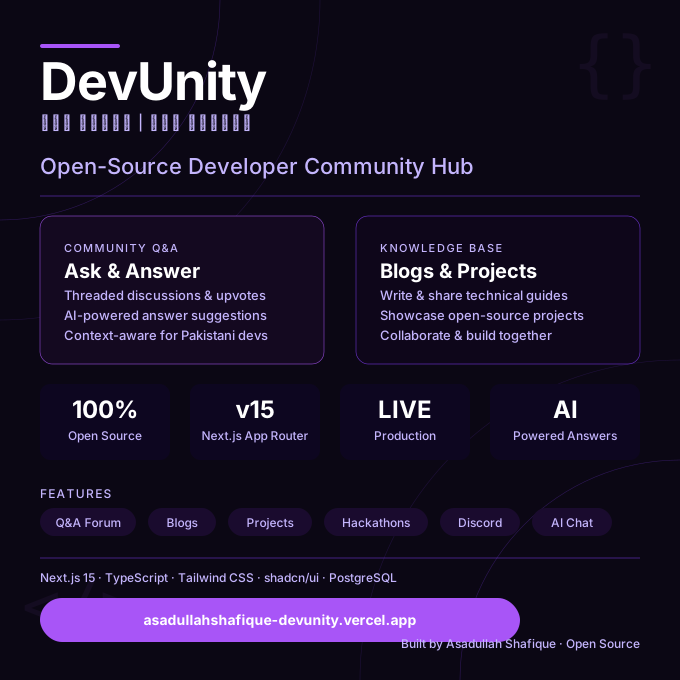
Pakistani developers lack a local, context-aware Q&A platform. Most alternatives are too generic and not community-driven.
Solution
Open-source community platform with threaded Q&A, blogs, project collaboration, and AI-powered answer suggestions. Built with Next.js 15 App Router and shadcn/ui.
Impact
Live, with source and a running deployment. This site is that codebase: the Agents SDK orchestrator, the MCP server and the constitution all ship from this repository.
Shipped platforms and products built on the same methods, with real data behind them.
Completed
Phase I Console Todo: Clean Architecture in Pure Python
Zero runtime dependencies, by design not by accident
A console todo application built to prove that clean architecture holds without a framework: repository pattern, service layer, dependency injection, and an empty dependency list.
Most 'clean architecture' demos import a web framework and an ORM on line one, which quietly makes the architecture untestable in isolation and the claim unfalsifiable. The interesting question is whether the layering actually holds when nothing external is propping it up.
Solution
Four layers with one direction of dependency: domain entities that validate themselves, an abstract repository interface, an in-memory implementation behind it, and a service layer holding the business rules. The console is a thin adapter injected at the composition root. Because storage is an interface rather than a database call, the whole application runs on the standard library alone - the dependency list is empty and that is the proof, not the marketing.
Impact
50 tests pass with no third-party runtime dependency. Auditing it surfaced two real defects the suite was already failing on: a task due today was rejected, because dates parse to midnight and were compared against the current time, so 'today' was in the past at every moment except midnight itself - while the error message claimed the present was allowed. And update parsed a due date but never validated it, so the rule enforced on create was silently skipped on update. Both are fixed, share one validation helper, and are pinned by regression tests computed relative to now() so they cannot rot the way a hardcoded date does.
Most agentic pilots in financial services die at the compliance review, not because the models are weak, but because a system that cannot show why it reached a conclusion cannot be signed off by a second line of defence. A control a model can argue its way past is not a control.
Solution
Three specialised agents, MarketAnalyst, ComplianceOfficer and WealthStrategist, on a fixed Plan-Act-Verify state machine rather than a conversation. Compliance is structural: no agent holds two of the three powers (market data, setting weights, rendering the verdict), and there is deliberately no graph edge from drafting a recommendation to approving one, so verification cannot be skipped under load or disabled by a flag. Shari'ah and regulatory principles live in a versioned constitution reviewed like code, and anything expressible as arithmetic is settled in Python with no model involved.
Impact
A full compliance screen runs in under 2ms with zero model calls, settling 8 of 14 principles by arithmetic, reproducible offline at no marginal cost. Every run writes a hash-chained, tamper-evident audit trail. 94 tests pass with no API key and no network, and the screening engine is deployed live and interactive, so every figure here can be checked in one click.
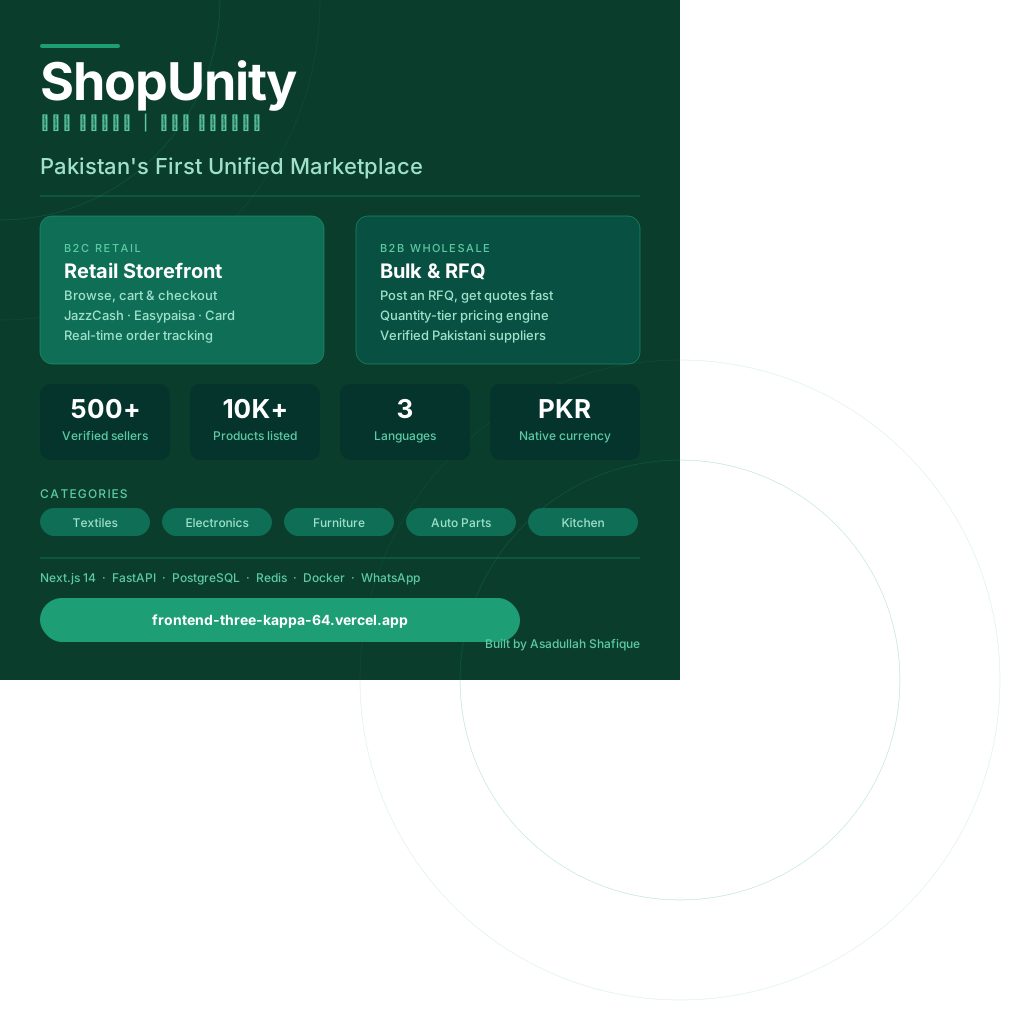
Pakistan's first unified marketplace with dual B2C retail storefront and B2B wholesale/RFQ engine, 500+ verified sellers, 10K+ products, JazzCash/Easypaisa/Card payments, and PKR-native currency. Built for local SMEs and enterprise adoption.
Local SMEs in Pakistan and the UAE have no unified digital storefront. Buyers juggle multiple platforms, vendors lack analytics, and enterprise clients need white-label flexibility, all three groups are underserved by existing solutions.
Solution
Bazaar unifies B2C retail (browse, cart, checkout, JazzCash, Easypaisa, Card) and B2B wholesale (RFQ engine, quantity-tier pricing, verified suppliers) into one platform. Architecture: multi-tenant Next.js 15 storefront, FastAPI microservices, Supabase BaaS for auth/realtime, local + Stripe payment gateways, vendor dashboard with analytics, AI-powered recommendations, and a white-label enterprise tier.
Impact
500+ verified sellers, 10K+ products across Textiles, Electronics, Furniture, Auto Parts & more. PKR-native, 3 languages (EN/UR/AR). Modular design means each tier is additive, one codebase, SME to enterprise scale.
AI TradeFlow: Inventory & Accounting for Wholesalers
AI for Pakistan's Trade Economy, Portfolio Project 1
Bilingual AI-powered inventory & accounting platform for Pakistani wholesalers, with Munshi AI, a constitutionally-guarded digital accountant that reads your own data and answers 'what should I order this week?' with cited, grounded recommendations.
Pakistan's wholesalers and traders run multi-crore operations on paper registers, WhatsApp voice notes, and memory, no real-time stock visibility, chaotic udhaar (credit) tracking, and reorder decisions made on gut feel instead of data.
Solution
A bilingual (Urdu + English) inventory and accounting platform with a real digital FTE, Munshi AI, an OpenAI Agents SDK agent with 5 read-only tools and a deterministic constitutional guardrail that blocks fraud/tax-evasion requests before any LLM call, never fabricates a number, and gracefully degrades to tool-grounded answers if the model API fails. FastAPI + SQLAlchemy + Alembic backend, a Next.js web app, and an Expo mobile companion, all against one shared API.
Impact
90 automated tests, including full-trade-cycle API integration tests and agent golden-question suites with tool-citation assertions. Proper FIFO udhaar aging, not a balance heuristic. First project in the 'AI for Pakistan Trade' series, back-office module now, sourcing/logistics/negotiation phases to follow.
Pakistan's textile industry, CMT stitching units, garment factories, fabric mills, runs on WhatsApp messages, Excel sheets, and paper ledgers. Billing errors, zero production visibility, and manual inventory cost real money every day.
Solution
Multi-tenant SaaS ERP. Module 1 (Fabric Mill): roll/lot management, weaving & knitting stage tracking, yarn inventory, imported fabric. CMT modules: full order lifecycle, auto-billing across 4 bill types, BOM inventory, production sessions, dispatch, party ledgers, and cash tracking.
Impact
Targeting Faisalabad, Sialkot, Gujranwala, Karachi, and Lahore, Pakistan's full textile heartland. Multi-tenant SaaS on Kubernetes. Launching 2026.
Specialised ERP for stitching units and packing departments. Order tracking, machine allocation, QC checkpoints, packaging labels, and export documentation, built for Pakistan's garment exporters.
Comprehensive textbook platform with RAG chatbot built during Panaversity Hackathon (H1) using specification-first development and Spec-Kit Plus methodology.
Real multi-agent code and real test suites running against synthetic domain data. They demonstrate an architecture; they are not deployments with a production track record.
Constitutional AI foundation. Established the spec-first methodology and constitutional constraint patterns that persist across all 6 subsequent hackathons.
2024Online
TypeScriptConstitutional AILLMs
What I Offer
AI development, digital marketing, and industry-specific SaaS, built for real businesses.
Digital Marketing
Full-spectrum digital marketing for Dubai real estate, UAE construction, and Pakistani businesses. Strategy, social media, paid ads, property portals, and monthly reporting.
└ 40% lower cost-per-lead — Al Rashidi Real Estate, Dubai
A full-spectrum ERP for Pakistan's textile industry, from fabric mills to garment exporters. Module 1 (Fabric Mill): roll/lot management, weaving and knitting stage tracking, yarn inventory, and imported fabric. Further modules: CMT order lifecycle, auto-billing, production sessions, dispatch, party ledgers, and financial accounts.
└ Module 1 of 7 in build · fabric mill to garment export
Join Waitlist →
Industries I Serve
Domain expertise built through real operations, not just consulting.
Textile & Garment
Pakistan · UAE · Turkey
Serving Pakistan's textile value chain: CMT stitching units, garment factories, fabric mills, and exporters across Faisalabad, Sialkot, Gujranwala, Karachi, and Lahore. Also UAE and Turkish sourcing houses.
Dubai & UAE Real Estate / Construction
Real estate · Contractors · Developers
Digital marketing, property portals, social media, and lead generation for the UAE construction and property sector.
Pakistani SMEs & Factories
Small and medium enterprises across Pakistan
AI tools, digital marketing, and SaaS solutions tailored for Pakistani businesses entering the digital economy.
// leverage
Beyond the Code
Engineering builds the system; these decide whether it reaches anyone. Unlike every other section here, none of them cites a file path — which is exactly why they get their own.
Video Sales & Pitching
Turning a product, a service or an idea into a video pitch that holds attention long enough to be believed. In an attention economy video is the shortest path from stranger to trust, and trust is the part that actually converts.
Content Creation
Blogs, posts, podcasts, reels — the engine of visibility. Published consistently it stops being marketing and becomes the record that answers whether this person can actually do the work, before anyone thinks to ask.
Persuasion under constraint: an ad, an email, a landing page. Strong copy turns attention into action, which makes it load-bearing for everything else on this list — none of it survives weak words.
Not hustle — systems. Packaging a skill into an offer, making the offer scalable, and running more than one income stream so no single client is a single point of failure. Strategy is the easy half; execution is the half that pays.
Reputation, packaged. A brand doing its job means opportunities arrive instead of being chased — clients, collaborations, and being in the room before the shortlist gets written.
Mindset is the input; shipped work is the only evidence. Goal-setting, resilience, and the habit loop that gets you through the plateau where most projects quietly stop.
The multiplier on every other skill here. Closing a deal, structuring a partnership, or defusing a conflict — the value you capture is decided at the table, not in the build.
Essays on agentic architecture, reliability, decision-making and technical communication — linked to the code wherever the code exists.
Summaries describe each article as published. Figures inside them are the article's own claims at the time of writing, not metrics this site independently verifies.
September 202614 min read
The Architecture of Agentic AI: Building Autonomous Systems That Think, Plan, and Act
An LLM that answers is not an agent. An agent is a control system with a model inside it — and almost every property that makes it trustworthy lives outside the model.
Changing the Game: Negotiation and Competitive Decision-Making
Most negotiations are decided before anyone speaks — by the alternatives each side walked in with and the biases they failed to notice. A practical framework for preparing, creating value without giving it away, running a team, staying steady under pressure, and learning from the result.
KSOR: The System of Record for Reliable Agentic AI
Memory tells an agent what it remembers. A system of record tells it what the organisation is prepared to stand behind. Why agents that act need the second — and what it takes to build one.
KSORSystem of RecordAgentic AIProvenanceGovernance
The Psychology of Killer Hooks & Addictive Storytelling
Most openings fail in the first sentence — not because they are badly written, but because they make no promise. Why some ideas hold attention while others are ignored, and how the same mechanics apply to products, docs, AI interfaces and architecture reviews.
People who follow my engineering work rarely see the shelf behind it. Here are the ten books I keep coming back to, split into two piles: what grounds me, and what sharpens me.
The 1–9–1 Rule: How AI Expands Possibility Before You Decide
Most people treat AI as a faster way to reach an answer. That's the least interesting thing it does. The real shift is upstream of the answer entirely — in how cheap it has become to see nine paths before committing to one.
AIDecision-MakingAgentic EngineeringFuture of Work
A public engineering archive spanning agent systems, full-stack applications, and business software. Selected work is curated by relevance, not volume.
Contributing to projects that empower developer communities worldwide: Pakistan, UAE, and beyond.
🧪
Quality Code
Documented code with a test suite in each agentic repository — counted per project, with CI coverage stated rather than implied. CLAUDE.md-driven spec-first delivery.
🤝
Community Impact
Sharing knowledge through blog posts, Discord, and open-source tools. DevUnity is the flagship.
From Dubai real estate to Faisalabad garment factories: feedback from the people I've worked with.
“The Textile ERP concept Asadullah presented is exactly what our industry needs. Our production tracking is currently all Excel and WhatsApp. This would change everything for CMT units like ours.”
Textile ERP Platform: Early Feedback
TM
Tariq Mahmood
Owner · Mahmood Garments, Faisalabad
“Asadullah has been one of the most consistent contributors in our hackathon series. His spec-first methodology and zero-defect delivery across six consecutive hackathons is a benchmark for other students.”
A focused developer community for agent orchestration, MCP, guardrails, evaluations, and production AI architecture.
Asadullah's Dev Hub
Build in public
Architecture Teardowns
Study the decisions behind real agent systems, including routing, tools, state, failure paths, and evaluation.
Build Logs & Reviews
Share work in progress, get practical feedback, and learn from repository and portfolio reviews.
Open-Source Collaboration
Find contribution opportunities, project partners, and focused discussions around systems being built now.
Channels
# general-chat
# agentic-ai
# nextjs-fastapi
# hackathon-teams
# project-showcase
# resources
Free to join · Focused discussions · Practical builds
// contact
Get In Touch
Have a project idea, want to collaborate, or just say hello? Drop me a message!
Request a Consultancy Session
Three ways I engage. Each one names the code in this repository that backs it, so you can check the capability before the call.
Agentic System Audit
For existing AI setups
A review of an agent stack already in production: routing, guardrails, tool grounding, and whether its answers can be explained after the fact. Delivered as findings against a written eval suite, not impressions.
└ evals/ · backend/constitution/
Custom MCP Server Development
For enterprise data
Exposing an institutional data estate to agents as MCP tools that run inside your perimeter, read-only by default. The server here is real and verified against a live client, not a REST endpoint called MCP.
└ /mcp/server · 6 tools
Cloud-Native AI Transformation
For scaling prototypes
Taking a notebook or a demo to something that survives deployment: containers, autoscaling, network policy, health checks, and a fallback ladder that degrades instead of failing.
└ k8s/ · backend/Dockerfile
Affiliations
Panaversity
Agentic AI program — 6/6 hackathons shipped
Texcot House
Textile sourcing — own operation
Where the experience comes from. Not client endorsements.
Turn an AI workflow into a reliable system.
If you have an AI prototype, operational bottleneck, or integration challenge, share the context, desired outcome, and current stack. I’ll respond with the most useful next step.